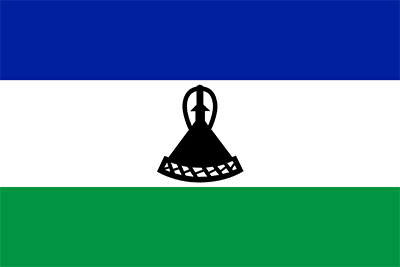
Country Context
HRF classifies Lesotho as democratic.
Lesotho is a constitutional monarchy, with a King serving as Head of State and an elected Prime Minister acting as Head of Government. Current Prime Minister Ntsokoane Samuel Matekane was democratically elected as an opposition challenger in the 2022 general election. Lesotho experienced two consecutive, competitive, free, and fair elections before it gained independence from Britain in 1966, but a 1970 coup heralded nearly a quarter of a century of authoritarian rule amid political instability marked by a civil war, an insurrection, and three additional coups by both civilian and military leaders.
Key Findings
National elections in Lesotho are largely free and fair. Since competitive, multi-party elections inclusive of the real, mainstream opposition resumed in Lesotho in 1993 after a 23-year hiatus, five different parties have rotated in power: the Lesotho Congress for Democracy (LCD), All Basotho Convention (ABC), Basutoland Congress Party (BCP), and the Democratic Congress (DC).
Independent media and regular people are seriously and unfairly hindered in their ability to openly criticize or challenge the government, facing retaliation. Independent journalists frequently face harassment, including death threats and murders.
The judiciary largely serves as a check on the government, especially in its ability to stop attempts by the executive to repress dissent. However, it fails to hold security forces accountable for human rights abuses by the Armed Forces and Police.
National elections in Lesotho are largely free and fair. In 2022, Sam Matekane, leader of the Revolution for Prosperity (RFP) party, assumed office as Prime Minister and Head of Government in an election regarded as free and fair by various domestic and international election observation missions. The RFP secured 56 out of 120 seats in the National Assembly but fell short of an absolute majority. To achieve a parliamentary majority and form a stable government, the RFP established a coalition with two smaller parties—the Movement for Economic Change (MEC) and the Alliance of Democrats (AD)— and established a stable government. This election reinforced the pattern of power alternation in the country over the past decade, demonstrating that the opposition has a genuine chance of gaining power through free and fair elections.
The government does not unfairly bar any mainstream opposition party or candidate from competing in elections or significantly hinder the electoral campaign of a mainstream opposition party or candidate. Also, it does not enjoy significant campaign advantages that seriously undermine the mainstream opposition’s ability to compete.
The government has not seriously undermined independent electoral oversight. The Independent Electoral Commission (IEC) comprises a Chairperson and a Deputy Chairperson, appointed by the independent Judicial Service Commission (JSC), and five members recommended by the All Party Conference – a consultative forum for all registered political parties in the country.
Under the Public Offices Election Law, election campaigns are highly regulated, with limitations on media usage, such as equal media access and regulated advertising among candidates, and spending for candidates. There are strict limits on the total amount of money a candidate can spend on their campaign, as well as the amount and source of donations that candidates can receive.
Independent media, political leaders, civil society leaders, organizations, and regular people are seriously and unfairly hindered in their ability to openly criticize or challenge the regime.
Radio is the most popular medium in Lesotho, with both domestic and South African broadcasts available, including state-run Radio Lesotho and the sole state-owned TV station. While the government generally respects media freedom and private outlets carry opposition views, the threat of defamation lawsuits has fostered self-censorship. Journalists have faced violence and threats, with some being shot, assaulted, or forced to flee. The trial of four soldiers accused of the 2016 attempted murder of journalist Lloyd Mutungamiri remains delayed as of 2022. The assassination in May 2023 of prominent investigative journalist and government critic Ralikonelo Joki of leading radio station Ts’enolo FM by unknown assailants and the ongoing impunity surrounding the case have cast a chill on journalists. Joki’s radio program was often critical of politicians and government policies, and he had received death threats. Two years before his murder, he exposed a story about five politicians involved in the illicit alcohol trade.
Journalists investigating sensitive matters such as government failures, mismanagement, or high-level public corruption have faced intimidation. On April 17, 2024, members of the leading independent Lesotho Tribune team found three threatening notes on their newsroom desks stating, “Stay away from Pension Fund matters if you still value peace in your home.” The threats referred to the newspaper’s January and February 2024 investigations into alleged mismanagement of Lesotho’s Public Officers’ Defined Contribution Pension Fund and followed legal efforts by a government service provider to stop the newspaper from publishing further articles on the topic.
While protests are rare, Lesotho’s defense and security forces systematically and violently suppress peaceful protests when they occur, a pattern that has carried over from the previous government. On May 23, 2023, Lesotho Defence Force officers shot rubber bullets and tear gas to disperse peaceful protests by communities affected by the construction of the Polihali Dam in the Mokhotlong district. The communities were protesting against inadequate and delayed compensation, lack of consultation, and other related issues during the launch of the Lesotho Highlands Water Project Phase II. In June 2022, police opened fire on unarmed students at the National University of Lesotho who were protesting against cuts to their living allowances. The gunfire resulted in the death of one student, Kopano Francis Mokutoane, and injuries to several others. In May 2021, police fired rubber bullets and live rounds at garment workers who were peacefully protesting against delayed minimum wage increases, resulting in injuries to at least eight workers.
Lesotho civil society organizations (CSOs) operate under the umbrella of the Lesotho Council of NGOs and play a pivotal role in implementing development initiatives in HIV/AIDS, agriculture, food security, climate change, education, health, child protection, WASH, and budget analysis, among other areas. Few CSOs act as watchdogs in the Governance sector; this role is played more by regional organizations. CSOs have expressed concerns about the reintroduction by lawmakers from the governing coalition in the National Assembly of the Computer Crime and Cyber Security Bill, 2024. The bill includes overly broad provisions criminalizing the vague offense of dissemination of false information and grants extensive powers of surveillance to law enforcement agencies, without sufficient oversight. Critics argue that certain provisions of the bill could criminalize legitimate journalistic activities and suppress free speech.
The judiciary largely serves as a check on the government. The constitution guarantees judicial independence, but it gives the King power to appoint the chief justice and other justices of the Court of Appeal and the judges of the High Court, with the advice of the elected prime minister and/or the Judicial Service Commission, which is heavily dominated by the executive branch.
In April 2024, the High Court dismissed an injunction filed by government service provider Fusion Investment Managers to prevent the Lesotho Tribune from publishing any more articles on their investigation into alleged mismanagement and corruption at Lesotho’s Public Officers’ Defined Contribution Pension Fund. In March 2024, the High Court dismissed a case brought by former Police Commissioner Holomo Molibeli, which sought to shut down the Lesotho Times newspaper over an investigation alleging his involvement in a cover-up of a $2.2 million fraud scandal at an energy scandal. He had sued the Lesotho Times for allegedly publishing a defamatory news article about him in connection with a fraud case involving the fuel company Tholo Energy.
The Court of Appeal has intervened to prevent executive abuses of power. On September 12, 2022, Lesotho’s High Court ruled that the State of Emergency declared by the Prime Minister on August 16, 2022 was unconstitutional. The emergency was used to recall Parliament and pass two amendment bills concerning changes to the Constitution and the Electoral Act.
Outside the scope of the electoral process, the judiciary has failed to hold government officials accountable, particularly for actions that seriously undermine freedom of dissent. For example, the public prosecutor has failed to charge police officers who served disciplinary suspensions for deadly brutality against protesting students from the National University of Lesotho in 2022, including the killing of a student, Kopano Francis Mokutoane. By January 2025, more than two years after the killing, the police officers suspected of involvement had returned to work. This is despite a public statement by Lesotho’s Chief Justice Sakoane Sakoane, in March 2023, expressing the judiciary’s demonstrated concern about the systematic use of disproportionate force by security forces to suppress protests.
In an attack on the judiciary, in August 2024, Lesotho Defence Force (LDF) chief, Major General Matela Matobakele, publicly threatened retaliation against judges and lawyers who may defend or rule in favor of suspected criminals arrested by the military. Prime Minister Sam Matekane has deployed the LDF against criminal gangs since August 2024.