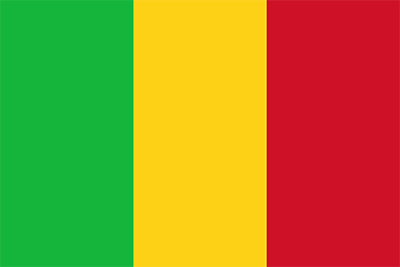
Country Context
HRF classifies Mali as ruled by a fully authoritarian regime.
Mali is a unitary state. The Head of State, Gen. Assimi Goïta, has suspended democratic constitutionalism since first leading an August 2020 military coup, which ousted the last elected civilian president, Ibrahim Boubacar Keita. The military takeover came amid mass protests against Keita’s regime over the presence of French troops, worsening insecurity from terrorism and a separatist insurgency in northern Mali, and corruption. Goïta, who expelled French troops and invited the Russian private mercenary group Wagner, staged another coup in May 2021. The junta has repeatedly delayed its promise to hold general elections, and it has extended the period of transitional military rule from 18 months to five years. With the military battling several armed groups—including terrorists, separatists, and insurgents—which have been contesting the state’s control over some parts of northern and central Mali since 2012, the regime has made criticism of the military or its operations against these groups a crime.
Key Findings
Direct national-level elections, such as parliamentary or presidential elections, have been absent in Mali since the military junta seized power and suspended constitutionalism. The regime has taken measures to unfairly hold on to power, including repeatedly delaying the organization of fresh elections to restore democratic constitutionalism. The regime has unfairly and significantly hindered the real, mainstream opposition.
The regime seriously undermined independent electoral oversight. The cabinet and the minister of territorial administration control the process of formal appointment of the 15 commissioners of the Independent Authority for the Management of Elections, eight of whom are hand-picked by public officials.
Independent media, civil society leaders, organizations, and regular people face overt and systematic retaliation if they openly criticize the regime. The regime has unfairly shut down or taken measures that led to the shutdown of major independent, dissenting organizations. The regime has heavily manipulated media coverage in its favor. The regime has seriously intimidated independent, dissenting media, political leaders, civil society leaders, organizations, or regular people, or otherwise seriously and unfairly obstructed their work.
The judiciary fails to serve as a check on the regime’s attempts to significantly undermine electoral competition and repress those who express open opposition to its policies. Judges who rule contrary to regime interests or who are perceived as a threat to the regime frequently face regime retaliation. The regime has seriously undermined institutional judicial independence.
Direct national-level elections, such as parliamentary or presidential elections, have been absent in Mali since Gen. Assimi Goïta’s military junta seized power in August 2020, ousting the last elected civilian president, Ibrahim Boubacar Keita.
The junta has repeatedly delayed its promise to hold general elections and has extended the period of transitional military rule from 18 months to five years. No definitive general election dates have been set.
The regime has taken measures to unfairly hold on to power, including by modifying the constitution or electoral laws. In June 2023, the military regime organized a national referendum vote to approve a new constitution, which, among other things, grants amnesty to junta members as well as eligibility to run for elected office, and increases the powers of the President. The real, mainstream opposition denounced the referendum as illegitimate and lodged a legal challenge against the vote. This measure followed a March 31 call from over 80 organizations demanding the immediate restoration of constitutional order through presidential elections.
The regime seriously undermined independent electoral oversight. Under a June 2022 electoral law, the cabinet and the minister of territorial administration control the process of formal appointment of the 15 commissioners of the Independent Authority for the Management of Elections, eight of whom are hand-picked by public officials.
The regime has unfairly and significantly hindered the real, mainstream opposition. Some major opposition figures have been the target of criminal prosecutions and fled into exile, with some forming a parallel government abroad. Other opposition figures have been imprisoned, and the junta has formally dissolved several opposition groups. From April to July 2024, the junta suspended political activities in the country, and since June 2024, it has imprisoned 11 leaders of the 31 March Declaration Opposition Platform, a coalition of parties demanding a return to the constitutional order, for holding a political meeting.
Independent media, political leaders, civil society leaders, organizations, and regular people face overt and systematic retaliation if they openly criticize the regime.
The junta has seriously intimidated independent media with censorship measures, threats, harassment, politically-motivated prosecutions, arbitrary arrests, abductions, enforced disappearances, and extrajudicial detentions, fostering a climate of fear and self-censorship among media operators. For example, in June 2024, state security agents abducted journalist Yeri Bocoum and detained him incommunicado for three weeks without charge after he covered a banned demonstration against electricity shortages and the high cost of living.
Amid grave diplomatic tensions with France, the junta has retaliated against a number of critical French international media outlets such as Radio France Internationale (RFI), France 24, TV5 Monde, and La Chaîne Info (LCI). The authorities also blocked French journalist Benjamin Roger from entering the country.
The regime has abused vague laws to seriously and unfairly censor dissenting speech. Prominent critics who have been convicted and imprisoned under vague and politically-motivated offenses such as spreading fake news, disturbing public order, discrediting the state, inciting revolt, or opposing the exercise of legitimate authority, include economist, university professor Etienne Fakaba Sissoko, influential political activist Adama Ben Diarra, known as Ben the Brain, and social media influencer Rokia Doumbia.
The regime has used other forms of serious extralegal intimidation against other critics, particularly those accusing the Malian armed forces and Wagner paramilitaries of atrocities against civilians. For example, gendarmerie Colonel Alpha Yaya Sangaré has disappeared since his March 2024 abduction by state security agents following the publication of his book containing such allegations. In another example, in January 2023, the regime orchestrated a campaign of public smears, denigration, and threats against Aminata Cheick Dicko, vice president of the human rights organization Kisal, in response to her testimony before the UN Security Council in which she accused Wagner paramilitaries of atrocities. The threats forced her to flee the country.
The regime has unfairly shut down major independent and dissenting organizations since 2021. The civil society and political organizations include the Coordination of Organisations of the 20 February Appeal to Save Mali, the Coordination of Movements, Associations and Sympathizers of Imam Mahmoud Dicko, Synergy of Action for Mali, Association of Pupils and Students of Mali, the Elections and Good Governance Observatory, and Kaoural Renouveau.
The regime has also seriously intimidated political leaders from the previous regime and the mainstream opposition. In June 2024, the junta imprisoned 11 leaders of the 31 March Declaration Opposition Platform, a coalition of parties demanding a return to the constitutional order, for holding a meeting in a private residence. In August 2021, it imprisoned former Prime Minister Soumeylou Boubeye Maïga on corruption charges, but the latter passed away in detention in March 2022 while awaiting trial.
The judiciary fails to serve as a check on the regime.
The regime seriously undermined judicial independence to the point where cases challenging the regime are no longer brought to the courts or are generally dismissed. For example, in April 2024, the Constitutional Court, the nation’s highest court, declined to review a legal petition by more than 80 political parties and associations seeking the affirmation of the illegality of the junta’s rule beyond March 2024, the junta’s own set deadline for the end of the military transition. The Court also dismissed a related petition challenging the legality of the junta’s April 10 decree suspending the activities of political parties and activities of a political nature of civil society organizations. In another case in July 2023, the Constitutional Court dismissed a legal petition by the real, mainstream opposition for the annulment of the results of the junta’s controversial constitutional referendum.
Judges who rule contrary to regime interests or who are perceived as a threat to the regime frequently face regime retaliation. For example, in September 2021, the regime removed senior magistrate Mohamed Chérif Koné from the Supreme Court over his public criticism of alleged military interference in the judiciary and irregularities in the arrest and prosecution of former prime minister Soumeylou Boubѐye Maïga, who died in pretrial detention in 2022. In August 2023, the regime orchestrated the disbarring of Koné and Dramane Diarra, another magistrate critical of the regime, a few months after the minister of justice announced an investigation against them for “opposition to legitimate authority.”
Before the military takeover in August 2020, the courts frequently and unfairly failed to check the regime’s attempts to significantly undermine electoral competition or make the electoral process significantly skewed in its favor. In April 2020, Mali’s Constitutional Court invalidated the results of around thirty parliamentary seats won by the opposition. The court, upon reviewing the appeals lodged by the candidates, awarded the ruling party 10 additional seats beyond the initially reported provisional figures, contributing to public anger that fueled a mass protest movement over a number of grievances that led to the government’s overthrow.
Malian courts also frequently and unfairly failed to check the regime’s attempts to repress criticism or retaliate against those who express open opposition to its most prominent, widely publicized policies. They have disproportionately focused on prosecuting high-profile figures from the previous administration, including former Prime Ministers Soumeylou Boubeye Maiga (as mentioned above) and Boubou Cissé, on corruption charges.
Courts frequently and unfairly failed to hold regime officials accountable, particularly for actions that seriously undermine electoral competition or freedom of dissent. Malian courts have not prosecuted any military officers for numerous reported rights violations and atrocities perpetrated against civilians during anti-terrorist and counter-insurgency operations, including extrajudicial killings, torture, and arbitrary arrests. For example, the military junta and Russian Wagner mercenaries have been implicated in over 300 incidents of abuse against innocent civilians, including the horrific March 2022 Moura massacre that resulted in the deaths of 500 Malian civilians. Although the Minister of Justice has initiated an investigation, no military personnel have faced prosecution, as the inquiry has stalled without any progress to date.